

The Canadian Sport Governance Code may not be something community sport clubs think about every day. Developed primarily for National Sport Organizations (NSOs), the Code establishes governance best practices around areas such as transparency, accountability, board responsibilities, athlete representation, risk management, and organizational oversight.
For clubs that are affiliated with Provincial Sport Organizations (PSOs) or National Sport Organizations, these principles still provide useful context for thinking about how programs are managed and how information is documented.
One area that deserves particular attention is program data.
When athlete evaluations, participation records, program outcomes, and other operational information are structured and consistently maintained, organizations have better evidence to support decisions, communicate results, and demonstrate accountability.
The Canadian Sport Governance Code does not prescribe a specific athlete evaluation platform or require community clubs to maintain a particular type of program database. Instead, its broader governance principles provide a useful framework for thinking about how organizations can make their decision-making and reporting more transparent and evidence-based.
This article explains what the Canadian Sport Governance Code is, how its governance principles connect to program data practices, and what clubs, PSOs, and NSOs can do to build stronger systems for managing program information.
What Is the Canadian Sport Governance Code?
The Canadian Sport Governance Code was developed through a process led by the Canadian Olympic Committee and was released in 2021. It was created to encourage stronger governance practices within Canadian sport organizations, with an initial focus on National Sport Organizations. The Code addresses areas including board composition, independence, athlete representation, board responsibilities, committees, risk management, and transparency.
The Government of Canada’s current Sport Integrity Framework recognizes the Canadian Sport Governance Code as a source of established best practices in sport organization governance. At the same time, the federal government has moved away from requiring federally funded organizations to adopt the Code as a standalone instrument and instead incorporated five mandatory governance elements into its funding accountability mechanisms.
This distinction matters for community sport organizations.
The Code should not be treated as a blanket set of data requirements for every local sports club. Its direct scope and current federal funding requirements are more specific. However, the principles behind the Code provide a useful lens for organizations at different levels of the sport system that want to strengthen transparency, accountability, and decision-making.
Does the Canadian Sport Governance Code Apply to Community Sports Clubs?
Not necessarily.
The Code was structured primarily around National Sport Organizations, and its application to community-level clubs is not automatic. The Government of Canada’s recent reporting on sport governance also notes that some provincial and territorial governments use their own policies to establish governance requirements for sport organizations in their jurisdictions.
A community club may therefore be affected by governance expectations through its relationship with a PSO, NSO, funding organization, or provincial or territorial framework rather than through direct application of the Canadian Sport Governance Code itself.
That distinction is important because clubs should not assume that the Code creates a specific legal or compliance requirement to collect particular types of athlete or program data.
Instead, clubs can look at the Code’s broader governance principles and ask a practical question:
Do we have reliable information that allows us to demonstrate how our programs are performing and support the decisions we make?
That is where strong program data practices become valuable.
How Governance Principles Connect to Program Data
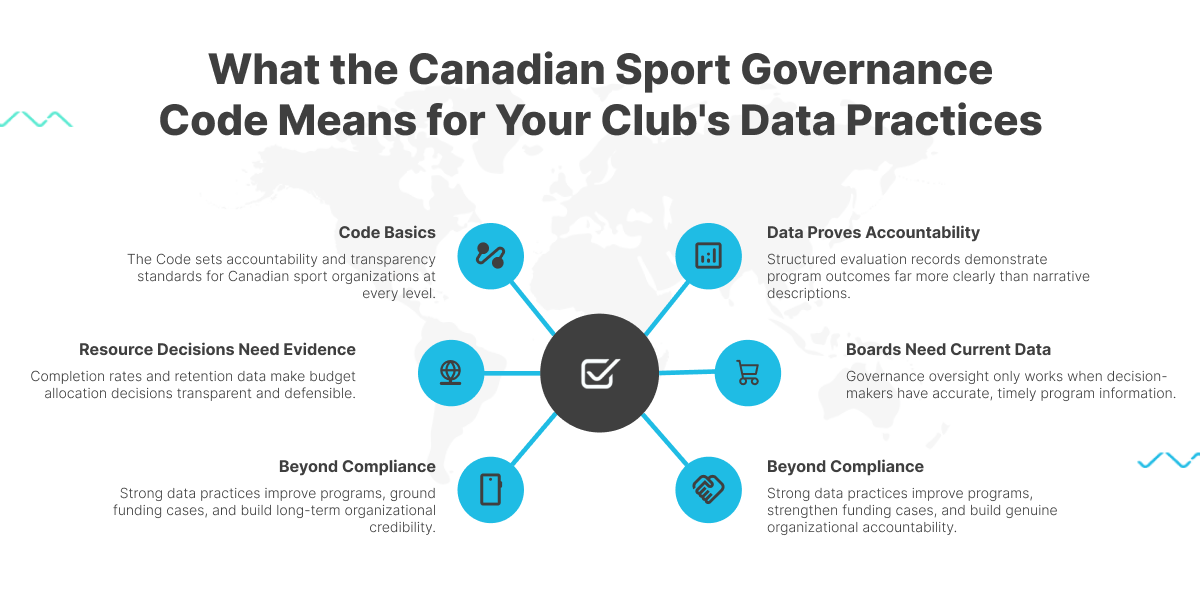
Good governance depends on organizations being able to make informed decisions, demonstrate accountability, and provide appropriate transparency.
Program data can support these objectives by creating a structured record of what is happening across programs and participants.
1. Structured Data Supports Accountability
A club may describe a successful season by saying that athletes improved, participation was strong, or coaches delivered the planned curriculum.
Those statements can be useful, but structured records provide a stronger foundation for demonstrating what actually happened.
For example, a club may maintain records showing:
- Which skills were evaluated
- How athletes progressed over time
- Which programs were completed
- Participation or completion rates
- Areas where athletes required additional development
- Program outcomes across different sessions or seasons
The purpose is not to collect data simply for the sake of having more data.
The purpose is to create useful evidence that can help the organization understand and communicate its results.
2. Program Evidence Can Support Resource Decisions
Sport organizations make resource decisions throughout the year.
They may need to determine:
- Which programs should be expanded
- Where additional coaching resources are needed
- Which development areas require more attention
- Whether a program should be changed
- Where funding should be allocated
- Which initiatives should continue into the next season
Having organized program information gives boards, administrators, and program leaders a stronger basis for those decisions.
Instead of relying entirely on anecdotal feedback, an organization can combine professional judgment with evidence from its programs.
That does not mean data should make every decision automatically. Rather, it gives decision-makers another reliable source of information when evaluating priorities.
3. Better Information Supports Governance Oversight
Board members and senior leaders need enough information to understand how an organization is performing.
If program information exists across paper forms, individual coach spreadsheets, emails, and disconnected systems, creating a clear organizational picture can be difficult.
Information may only be assembled when a board report, funding application, or annual review is due.
A more structured approach allows program information to be available throughout the season.
That can make it easier for leaders to identify trends, ask better questions, and understand how programs are progressing.
What Good Program Data Practices Look Like
Strong governance does not require every sport organization to use the same software or collect every possible data point.
It does, however, benefit from information that is:
Consistent
The same types of information are collected using consistent definitions and evaluation frameworks.
Structured
Information is organized in a way that makes it easier to review, compare, and report.
Accessible
Authorized administrators and decision-makers can access the information they need without relying on scattered records.
Timely
Data is captured close to when activities occur rather than reconstructed months later.
Useful
The organization collects information that can actually support program decisions and reporting.
Responsible
Participant information is handled appropriately and access is controlled according to the organization’s policies and applicable privacy requirements.
These principles can help clubs move from simply collecting information to creating a program data system that supports organizational decision-making.
What This Means for Community Sports Clubs
For a community sports club, the practical takeaway is relatively simple:
You don’t need to become a governance organization to benefit from better governance practices.
A club can strengthen its program management by creating a consistent process for recording and reviewing program information.
For example, clubs can:
- Standardize athlete evaluations so coaches use consistent assessment frameworks.
- Centralize program records instead of keeping information in separate spreadsheets or paper files.
- Track progress over time so coaches and administrators can see changes across seasons.
- Create consistent reports that summarize program outcomes.
- Review program data regularly rather than waiting until the end of the year.
- Document decisions and outcomes so future program planning is based on evidence.
- Establish appropriate data-access practices to help protect participant information.
These steps can make program administration easier while also giving clubs better evidence to use when communicating with boards, governing bodies, parents, funders, and other stakeholders.
What This Means for PSOs and NSOs
The opportunity becomes even greater at the governing-body level.
PSOs and NSOs often work with networks of affiliated clubs and programs. One challenge is that clubs may collect similar information in very different formats.
One club may use spreadsheets.
Another may use paper evaluations.
Another may use a different digital platform.
When information is inconsistent, it becomes difficult for a governing body to understand program performance across its network.
A standardized approach can change that.
When affiliated clubs use consistent evaluation frameworks and structured data collection processes, PSOs and NSOs can potentially gain a clearer view of:
- Program participation
- Athlete development
- Evaluation outcomes
- Program consistency
- Areas requiring additional support
- Trends across clubs or regions
- Progress over multiple seasons
This can also make organizational reporting more efficient.
Instead of asking every club to recreate information manually whenever a report is required, organizations can build processes in which useful program information is generated as part of normal program delivery.
How Checklick Supports Better Program Data Practices
Checklick is designed to help sports organizations bring structure to athlete development and program management.
At the club level, coaches can use structured skill matrices to evaluate athletes during regular sessions. Instead of relying on disconnected paper records or individual spreadsheets, evaluation information can be organized within a centralized system.
This creates a more consistent record of athlete development and program activity.
At the governing-body level, Checklick’s Evaluation Marketplace can help distribute standardized evaluation frameworks to affiliated clubs. This provides organizations with a way to establish greater consistency in how evaluation information is collected across their network.
For PSOs and NSOs, that consistency can make program information more useful for analysis, planning, and reporting.
The goal is not to collect more data simply because data exists.
The goal is to make the information generated through normal program delivery more structured, accessible, and useful.
Why Strong Data Practices Matter Beyond Governance
The value of good program data extends beyond governance.
A sports organization that has reliable program information can use it to understand what is working, identify areas for improvement, and make more informed decisions about future programs.
It can also help organizations communicate impact.
Instead of saying that a program “helped athletes improve,” an organization can use structured evaluation and participation information to explain what was delivered, what changed, and where additional development may be needed.
That can strengthen conversations with:
- Boards
- Parents
- Coaches
- Athletes
- PSOs
- NSOs
- Funders
- Community partners
In that sense, good data practices are not simply about compliance.
They are about building a clearer picture of how a sports organization operates and how its programs are serving athletes and communities.
Frequently Asked Questions
What is the Canadian Sport Governance Code?
The Canadian Sport Governance Code is a governance framework developed through a Canadian Olympic Committee-led process and released in 2021. It was designed primarily for National Sport Organizations and addresses governance practices related to areas such as board composition, athlete representation, independence, risk management, and organizational transparency. The Government of Canada continues to recognize it as a source of established governance best practices.
Does the Canadian Sport Governance Code apply to community sports clubs?
Not automatically. The Code was structured primarily around National Sport Organizations. Community clubs may encounter governance expectations through their relationships with PSOs, NSOs, funders, or provincial and territorial requirements, but the Code should not automatically be interpreted as a direct requirement for every local sports club.
Does the Canadian Sport Governance Code require sports clubs to collect program data?
The Code does not establish a specific program-data collection system for community sports clubs. However, maintaining structured and reliable program information can support broader governance objectives such as accountability, transparency, planning, and informed decision-making.
What types of program data can sports organizations track?
Depending on the organization’s needs, useful program data can include athlete evaluations, skill development, participation, completion rates, program outcomes, and other information used to understand program performance.
How can PSOs and NSOs benefit from standardized program data?
Standardized data can make it easier for governing bodies to understand programs across affiliated clubs, identify trends, support program planning, and produce more consistent reports. It can also reduce the need to manually consolidate information from different clubs and reporting systems.
How does Checklick help with program data?
Checklick helps sports organizations structure athlete evaluations and program information within a centralized platform. Its Evaluation Marketplace can also help governing bodies distribute standardized evaluation frameworks to affiliated clubs, creating greater consistency in how program information is collected.
Build Stronger Program Data Practices With Checklick
Good governance starts with good organizational practices. For sports organizations, that includes having reliable information about the programs they deliver and the athletes they support.
Checklick helps clubs, PSOs, and NSOs structure athlete evaluations and program information so that the data generated during everyday program delivery can become a useful resource for planning, reporting, and continuous improvement.
Learn more about Checklick and see how it can support your organization’s athlete development and program management needs.