
It is not usually asked out loud because it may feel impatient or ungrateful. But it is there, shaping how parents evaluate the experience and influencing the decision they eventually make about whether their child will continue.
The question is:
Is this actually working?
Is my child actually getting better? Can I see it? If I had to explain what my child learned this season, could I do it? Is there clear evidence of development, or is it simply a general feeling that things are moving in the right direction?
This is where athlete progress visibility becomes important.
Most sports clubs cannot answer these questions for parents in a specific and visible way. The coaching may be excellent. Athletes may be developing. But the evidence of that development often remains in coaches’ heads, paper evaluation forms, or systems that parents cannot access or easily understand.
The gap between the development that is happening and the visibility parents have into that development is one of the most significant—and most solvable—retention challenges in community sport.
This article explains why athlete progress visibility matters for sports club retention, what effective progress visibility looks like, and how clubs can make athlete development easier for parents and athletes to understand.
For more context on what happens when athletes do not continue between seasons, read our article on why sports clubs lose athletes between seasons and how to stop it.
Why Athlete Progress Visibility Is a Retention Mechanism
Progress visibility is often treated as a parent communication feature.
That framing understates how directly it can affect retention.
When parents can clearly see their child’s development throughout the season, three important things can happen.
1. Continuing Becomes the Next Step
A parent who has been watching their child progress through a development pathway knows where their child is and what may come next.
Re-enrolling for the next season becomes the continuation of something they have already been following.
The decision to continue has momentum behind it.
By comparison, a parent with little visibility into their child’s development may arrive at the re-enrollment decision with only a general impression of the season.
They may have enjoyed the experience but still ask:
- What did my child actually learn?
- How much progress did they make?
- What happens next?
- Is continuing worth the investment?
When progress is visible throughout the season, parents have clearer answers to these questions before the re-enrollment period arrives.
2. Visible Progress Can Create Advocacy
Parents who can clearly see and describe their child’s development are better positioned to talk about the program with other families.
Instead of saying:
“My child had a good season.”
They may be able to describe:
- Specific skills their child developed
- Milestones their child achieved
- Progress through different levels
- What their child is working toward next
Specific progress creates a more concrete story about the value of the program.
That can strengthen word-of-mouth recommendations and help parents communicate why they believe the club has been valuable for their child.
3. Parents See the Long-Term Value of the Program
When parents can see an athlete’s development pathway, they gain a clearer understanding of what the club is building toward.
They can see:
- Where their child started
- Where their child is now
- What skills have been achieved
- What comes next
This kind of athlete development visibility can make the program feel like a longer-term pathway rather than an activity evaluated one season at a time.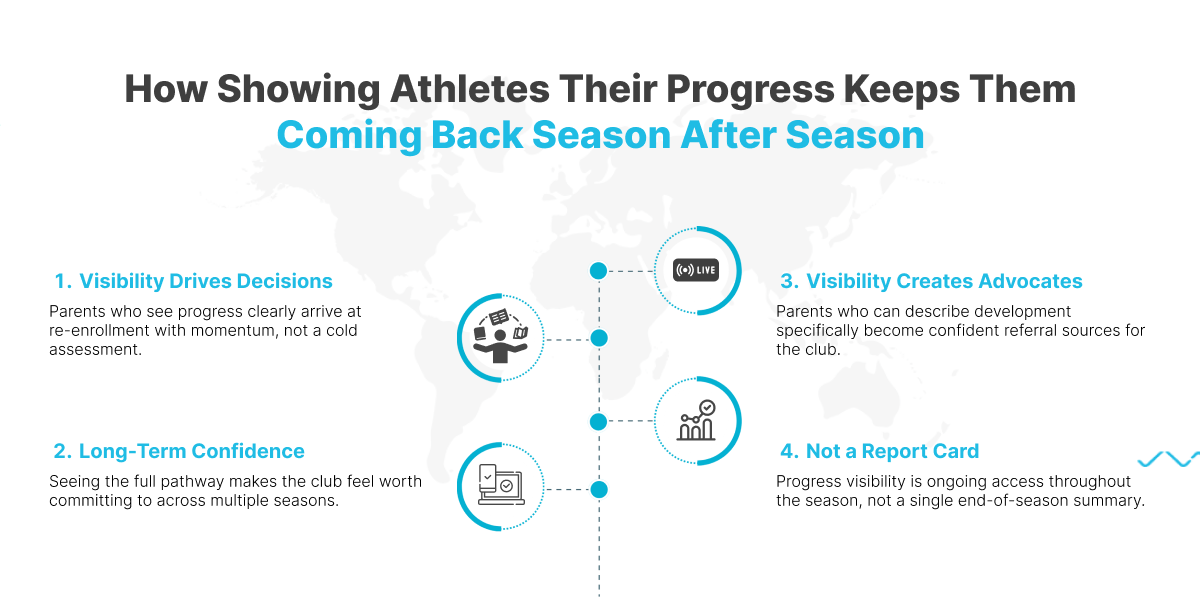
What Athlete Progress Visibility Actually Looks Like
Athlete progress visibility is not simply an end-of-season report card.
It is ongoing access to current information about where an athlete stands in their development throughout the season.
When a coach evaluates an athlete during a session using Checklick on a phone or tablet, the evaluation can become visible to the athlete’s parents through the platform.
This means:
- No separate report needs to be compiled
- No additional progress email needs to be written
- Parents can see milestones as they are achieved
- Athlete development becomes easier to follow over time
The progress information can become a natural result of the evaluation process already taking place during coaching.
See how Checklick’s evaluation platform makes athlete progress visible to parents
Parents with ongoing visibility can see when:
- A skill is completed
- Their child advances to a new level
- New skills are being evaluated
- Development goals are being achieved
This gives families more information about what is happening during the season.
Instead of relying entirely on a child’s recollection of what happened at practice, parents can have more informed conversations about their child’s development.
Checklick helps keep participants, parents, and coaches informed with personalized skill progression feedback. Frequent athlete evaluation can support communication and ongoing development by tracking progress, setting goals, and recognizing accomplishments.
How Port Credit Yacht Club Used Progress Visibility to Support Retention
Port Credit Yacht Club in Ontario identified declining adult program enrollment and difficulty retaining young sailors after their first seasons as key challenges.
Parents wanted clearer progress updates. Staff needed an easier way to demonstrate the value of the programs to families deciding whether to continue.
After adopting Checklick, staff used the platform’s progression displays to show parents where each participant stood in the program pathway.
The result was greater transparency for families and increased confidence in the club’s longer-term development pathway.
Custom questions in the registration process also captured how sailors heard about the club, giving the organization additional marketing insights.
Read the Port Credit Yacht Club success story
The key retention mechanism was not simply marketing.
It was visibility.
When parents could see where their child was in the development pathway and what came next, they had a clearer picture of the program’s value and future progression.
Building Athlete Progress Visibility Into Your Club’s Operations
Progress visibility does not necessarily require a separate communication process.
It can be built into the athlete evaluation workflow.
When coaches evaluate athletes during sessions using Checklick, those evaluations can flow into the platform as part of the normal coaching process.
Parents can then access progress information without requiring coaches or administrators to create separate reports for every athlete.
This can reduce the gap between:
Athlete development happening → Progress being recorded → Parents seeing that progress
For clubs that are not yet tracking athlete development digitally, the process can begin with a few steps.
1. Create an Evaluation Framework
Set up the skills, levels, or development criteria that coaches will use to evaluate athletes.
This creates a consistent structure for tracking athlete progress.
2. Give Coaches Access to the Platform
Coaches can access the evaluation system from their mobile devices during sessions.
This makes progress tracking part of the existing coaching workflow.
3. Begin Evaluating Athletes During Sessions
As athletes are evaluated, their development history begins to build.
Over time, the club develops a clearer record of each athlete’s progression.
4. Give Parents Visibility Into Progress
Parents can follow their child’s development rather than waiting until the end of the season for a summary.
See how Checklick’s evaluation tools work during sessions
Why Parent Communication Matters for Sports Club Retention
Parents are usually responsible for deciding whether a young athlete continues from one season to the next.
That decision is influenced by the overall experience, including whether parents understand the value their child is receiving from the program.
Good coaching is important.
Athlete enjoyment is important.
But parents may also want evidence that their child’s time, effort, and participation are contributing to development.
Showing athlete progress can improve parent athlete progress communication by giving families something concrete to follow.
Parents can see:
- Development milestones
- Completed skills
- Current progress
- Areas of continued development
- What may come next in the athlete’s pathway
The goal is not to overwhelm parents with data.
The goal is to make athlete development understandable.
Why Ongoing Progress Visibility Is Different From an End-of-Season Report
An end-of-season report provides a summary.
Athlete progress visibility provides an ongoing picture.
That distinction matters.
An end-of-season report tells parents:
“Here is what happened.”
Ongoing progress visibility allows parents to see development as it happens.
This creates a continuing connection between the family and the athlete’s development journey throughout the season.
Instead of waiting until the re-enrollment decision to demonstrate value, the club can make progress visible while the program is still underway.
A More Connected Athlete Development Experience
The strongest athlete development systems do not treat evaluations as information that disappears after a coach records them.
Evaluation data can become useful to multiple people.
For athletes
Progress visibility can help them understand their development and recognize achievements.
For parents
It provides clearer visibility into what their child is learning and how they are progressing.
For coaches
Evaluation records can help track development and identify areas requiring further attention.
For clubs
Centralized athlete data can create a stronger record of development across programs and seasons.
This is why athlete progress tracking can support more than evaluation.
It can contribute to communication, athlete development, parent confidence, and sports club retention.
Making Progress Visible Throughout the Season
For many clubs, the retention conversation happens too late.
Families are asked to re-enroll at the end of the season, after months of limited visibility into what their athlete achieved.
A stronger approach is to make development visible throughout the program.
When parents can see their child’s progression as it happens, they do not need to reconstruct the value of the season at the point of re-enrollment.
They have been following that value throughout the program.
For clubs that want to begin building this kind of visibility, Checklick provides a centralized evaluation platform for tracking athlete development and sharing progress information.
Frequently Asked Questions
Why does athlete progress visibility improve sports club retention?
When parents can see their child’s development clearly throughout the season, the decision to re-enroll can become the continuation of an ongoing experience rather than a cold assessment based only on a general impression of the season.
What is the difference between progress visibility and end-of-season reports?
Progress visibility provides ongoing access to current athlete development information throughout the season. End-of-season reports provide a summary after the program has ended.
How does Checklick make athlete progress visible to parents?
When coaches evaluate athletes during sessions using the Checklick platform, those evaluations can be made visible to parents through the platform, allowing families to follow athlete development as evaluations are recorded.
Can athlete progress visibility also support referrals?
Visible and specific athlete progress can give parents clearer information to discuss when recommending a sports program to other families.
Make Athlete Progress Visible
Parents should not have to wait until the end of the season to understand how their child is developing.
When athlete progress is visible throughout the season, families can better understand what has been achieved, what their child is working toward, and how development is continuing.
Start your free trial at Checklick.com and give parents the visibility that keeps them engaged season after season.