
Every fall, sports clubs bring on new coaches for the season.
Some are returning coaches taking on new groups. Others are completely new to the club. Some may be volunteers stepping into coaching roles for the first time.
Whatever the situation, the same challenge applies: the new coach needs to understand where each athlete is in their development, while the club needs to make sure the athlete data collected during summer is not lost during the transition.
This is where effective fall coach onboarding becomes more than simply giving a new coach a schedule, roster, and access to club systems.
A good onboarding process should also give coaches access to the athlete development history they need to continue coaching from the right starting point.
When athlete evaluations and development records are stored in a centralized system, a new coach can review the information before their first session. They can see which skills an athlete has completed, where the athlete finished at the end of summer, and which developmental areas may need additional attention.
The coach can continue from where the previous coach left off.
When athlete information is stored in paper forms, personal spreadsheets, or an outgoing coach’s memory, the transition can look very different. The new coach may start the season with little or no context about the athletes in their group and spend the first several sessions rebuilding information that already existed during the summer.
This article explains how sports clubs can improve fall coach onboarding, preserve athlete data across seasonal transitions, and build better continuity between summer and fall programs.
For a broader look at the overall coach transition process, see our guide on how to onboard new coaches at your sports club without losing athlete data.
What Fall Coach Transitions Look Like Without Centralized Athlete Data
Without centralized athlete tracking, fall coach onboarding can become unnecessarily repetitive.
A new coach may arrive for their first session with a registration list but little context about the athletes in their group.
They may know:
- Who is registered
- Which program the athlete joined
- When the season starts
But they may not know:
- Which skills the athlete completed during summer
- What level the athlete reached
- Which developmental areas require more attention
- Whether the athlete is ready to progress
- What the previous coach observed during earlier sessions
As a result, the first few weeks of the season may be spent observing and reassessing athletes to rebuild a picture that already existed.
By the end of several weeks, the new coach may have a reasonable understanding of the group.
The problem is that much of this information may already have been collected during the summer.
When athlete development records do not transfer with the athletes, the club loses continuity between programs.
This is more than a minor administrative inconvenience. Repeated assessments can delay progression and create unnecessary duplication in the coaching process.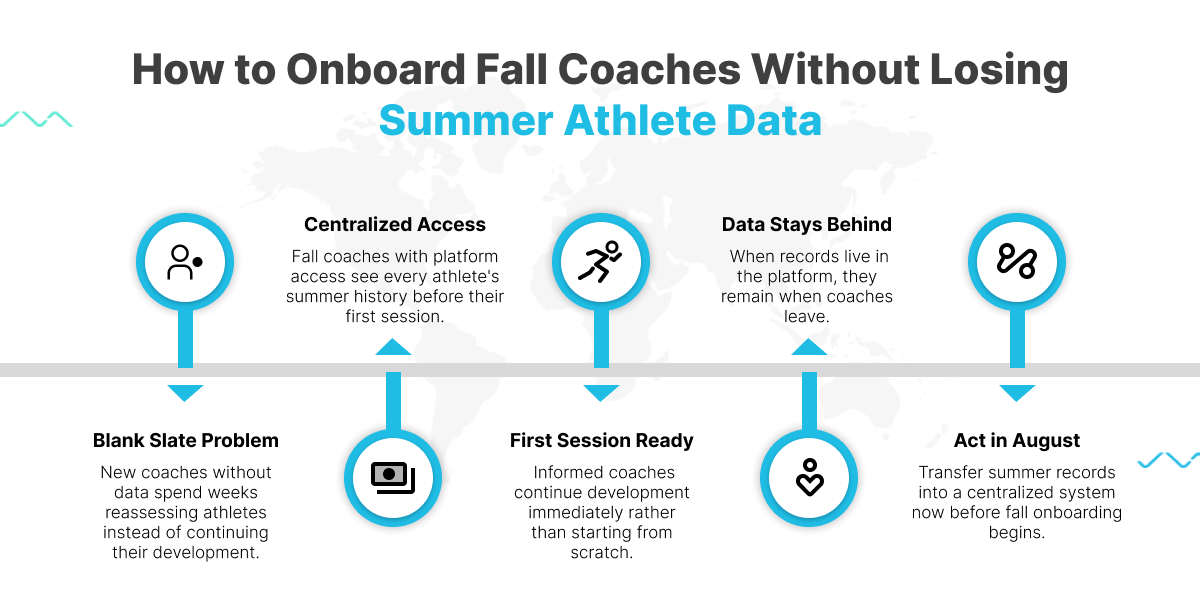
How Centralized Athlete Tracking Changes Fall Coach Onboarding
When athlete development is tracked through a centralized platform, the fall coach transition can work differently.
Before the first session, the incoming coach can be given appropriate access to the athletes and evaluation records relevant to their program.
They can review the athlete evaluation history and understand:
- Which skills each athlete demonstrated during summer
- What level each athlete completed
- Which athletes may be ready to progress
- Which athletes may need additional reinforcement
- Where developmental gaps may exist
The first fall session does not need to begin from a complete blank slate.
Instead, the coach can use the previous evaluation history as context while observing the athletes in their new environment.
This creates better athlete data continuity between seasons.
The coach still uses their professional judgment. They still observe athletes and assess their current performance. But they do so with access to the development history that came before.
Why Athlete Data Continuity Matters for Development
Athlete development does not stop when a summer program ends.
Each season should ideally build on the progress made during previous programs.
When a club loses access to past athlete records during a coach transition, the new coach may have to reconstruct an athlete’s development history.
That can make it more difficult to understand:
- Where an athlete started
- What progress has already been made
- Which skills have been completed
- Which areas require continued development
- Whether the athlete is progressing consistently over time
A centralized record allows the athlete’s development history to accumulate.
Summer evaluations can become part of the fall coach’s starting context. Fall evaluations can then contribute to the athlete’s longer-term record.
Over time, this creates a more complete picture of athlete progression across:
- Programs
- Seasons
- Coaches
- Development levels
What Good Fall Coach Onboarding Looks Like in Practice
A strong sports club coach onboarding process should include more than introducing the new coach to the team.
It should provide the information the coach needs to understand their athletes before the season begins.
Step 1: Give the Coach Access Before the First Session
The incoming coach should have access to the relevant athlete records before the season starts.
This gives them time to understand the group rather than trying to learn everything during their first session.
Step 2: Review Summer Athlete Evaluation Data
The coach can review the available summer evaluation history for each athlete.
They may identify:
- Athletes ready to advance
- Skills requiring reinforcement
- Developmental gaps
- Previous evaluation results
- Relevant notes from earlier sessions
Step 3: Use the Data as Context, Not a Replacement for Observation
Historical records should support coaching decisions.
The new coach should still observe athletes directly and confirm their current level of development.
The advantage is that observation begins from an informed position rather than a completely blank one.
Step 4: Continue Recording Development During Fall
The fall coach’s evaluations should contribute to the same centralized athlete record.
New information should build on the summer history rather than replacing it.
This allows the athlete’s development record to grow over time.
Step 5: Prepare the Next Coach for the Next Transition
When the fall season ends, the same information can support future transitions.
The next coach should not have to begin from zero.
This is how clubs build long-term continuity rather than repeatedly rebuilding athlete information every season.
How Centralized Data Supports Sports Club Continuity
A sports club should not depend on one coach’s personal files, spreadsheets, or memory to maintain its athlete development history.
When important information is tied to an individual person, the organization becomes vulnerable when that person:
- Changes roles
- Leaves the club
- Takes a different group
- Moves away
- Stops coaching
Centralized sports club data management reduces this dependency.
The information belongs to the organization and can remain available when coaching responsibilities change.
This principle applies to more than athlete evaluations.
Clubs may also need continuity across:
- Registration records
- Membership information
- Program participation
- Coach assignments
- Athlete development
- Program history
When these records are accessible through a centralized system, the organization can maintain continuity even when people and roles change.
Preparing for Fall Coach Onboarding in August
For clubs preparing for fall programs, August is an important time to review whether athlete information will be available to incoming coaches.
Ask:
- Is summer athlete data centralized?
- Can incoming coaches access the information they need?
- Are athlete evaluation records connected to the athletes rather than individual coaches?
- Can new coaches review development history before their first session?
- Is there a consistent process for recording fall evaluations?
If summer evaluation data was already collected digitally, much of the information may already be ready for the next coach.
If the information currently exists on paper or in personal spreadsheets, clubs can use the transition period to centralize as much relevant information as practical.
Even an incomplete transfer may provide more context than beginning the fall season without access to any development history.
The more important long-term goal is to ensure that future athlete evaluations are captured consistently so the club does not face the same problem during the next coach transition.
How Checklick Helps Clubs Maintain Athlete Data Continuity
Checklick helps sports clubs create a centralized record of athlete development.
Coaches can use structured evaluation frameworks to assess athletes during normal program delivery. Those evaluations can contribute to an organized athlete development history rather than remaining in separate paper records or individual spreadsheets.
When coaches change between summer and fall programs, the relevant athlete information can remain with the club.
A new coach can begin with access to the athlete development context they need instead of relying entirely on informal handovers or repeated assessments.
The result is a more consistent connection between:
Summer coach → athlete development record → fall coach
As each coach contributes new information, the athlete’s record can continue to develop over time.
Why Better Coach Transitions Matter to Families
Coach transitions affect more than internal club operations.
They also affect how families experience the organization.
When a new coach understands where an athlete is in their development, families are more likely to experience continuity between programs.
The athlete does not appear to be starting from the beginning simply because the coach changed.
A smooth transition can demonstrate that the club has systems in place to support the athlete’s development beyond the involvement of any individual coach.
That organizational continuity can help build confidence among:
- Parents
- Athletes
- Coaches
- Administrators
- Program leaders
Frequently Asked Questions
Why do sports clubs lose athlete data when coaches change?
Sports clubs can lose continuity when athlete evaluations and development records are stored in individual coaches’ files, spreadsheets, or personal systems. A centralized platform allows the organization to maintain athlete records independently of any individual coach.
How does centralized athlete tracking improve fall coach onboarding?
New coaches can review relevant athlete development and evaluation history before their first session. This gives them a starting point for understanding each athlete and reduces the need to rebuild information that was already collected during the summer.
Should a new fall coach completely trust previous athlete evaluations?
Previous evaluations should provide useful context, but the new coach should still observe athletes and use their own professional judgment. Historical data helps the coach start from an informed position rather than a blank one.
What should a sports club do if summer athlete data was collected on paper?
The club should centralize as much relevant information as practical before the fall season begins. This can provide incoming coaches with useful context while helping the organization move toward a more consistent digital process for future evaluations.
How can sports clubs maintain athlete data continuity between seasons?
Clubs can maintain continuity by keeping athlete evaluations and development records in a centralized system that remains accessible when coaches or programs change.
Give Your Fall Coaches the Full Athlete Development Picture
A new coach should not have to spend the first weeks of the fall season rebuilding information that already exists.
When athlete development records move with the athlete rather than remaining with an individual coach, every transition becomes easier.
Checklick helps sports clubs centralize athlete evaluations and maintain a more consistent development history across coaches, programs, and seasons.
Make sure your fall coaches start with the full picture of every athlete they work with.